


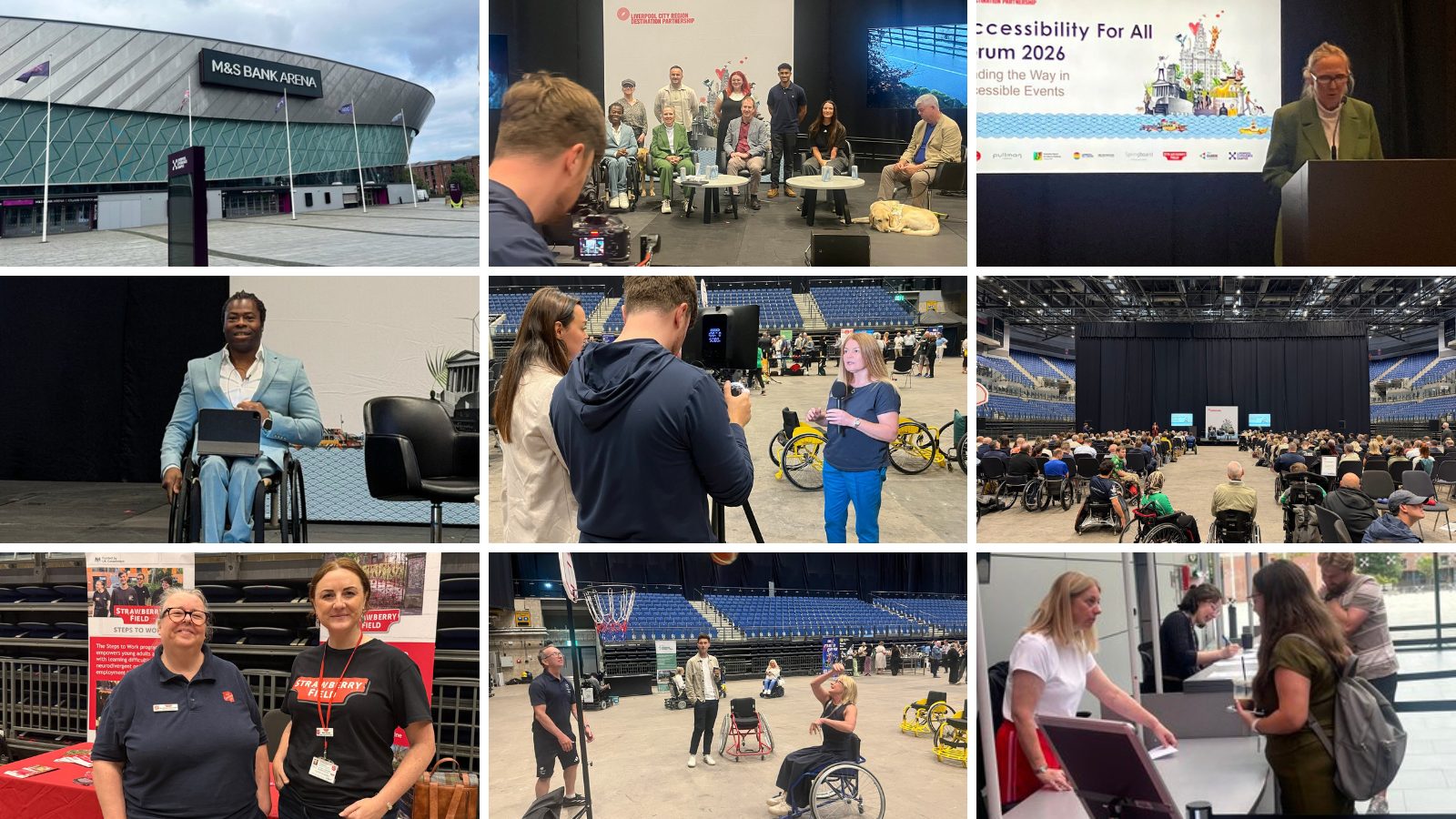
At the Liverpool City Region Accessibility for All Forum, held on the 29th June 2026, we asked delegates to share their views on how Liverpool City Region can become a more accessible destination.
More than 70 delegates contributed questions, ideas and feedback through Slido. We’ve reviewed the key themes and set out our responses, together with useful resources and actions already underway across the city region.
You Asked: What more can we do to ensure neurodivergent and learning disabled people are fully included in mainstream events, rather than segregated or only partially catered for?
We Responded:
True inclusion means designing events and experiences so that as many people as possible can participate together, rather than creating separate experiences. This includes:
- Providing clear, easy-to-understand information before arrival.
- Offering quiet spaces and sensory-friendly environments where possible.
- Training staff to understand different access requirements.
- Involving neurodivergent and learning-disabled people in event planning and evaluation.
- Considering accessibility from the start of event design, rather than as an add-on.
The LCRDP will continue working with partners and accessibility advocates to share best practice and encourage inclusive event planning across the visitor economy.
You Asked: What is one common misconception about accessibility that you wish more employers understood?
We Responded:
One of the most common misconceptions is that accessibility is expensive or only benefits a small number of people.
In reality, many improvements cost little or nothing to implement and create a better experience for everyone, including customers, visitors and employees. Accessible workplaces are more inclusive, help organisations attract diverse talent and often improve overall customer service standards.
Accessibility should be viewed as an investment in people, not simply a compliance requirement.
You Asked: How are organisations adapting recruitment practices to improve accessibility to employment opportunities?
We Responded:
Many organisations across the Liverpool City Region are reviewing recruitment processes to remove barriers and create more inclusive workplaces. Examples include:
- Providing application materials in accessible formats.
- Offering alternative interview arrangements.
- Using clear and inclusive job descriptions.
- Working with specialist employment support organisations.
- Focusing on skills and potential rather than traditional recruitment methods.
Creating accessible employment opportunities is an important part of building a truly inclusive visitor economy.
You Asked: What lessons can be learned when delivering large-scale events and attractions?
We Responded:
Major events provide valuable learning opportunities for all organisers. Feedback from attendees helps identify both good practice and areas for improvement.
The Accessibility for All Forum reinforced the importance of considering accessibility at every stage of event planning, including transport, wayfinding, seating, toilets, communication, ticketing and staff training.
We encourage all event organisers to engage with disabled people and accessibility specialists throughout the planning process to ensure continuous improvement.
You Asked: What can hotels do when they have a limited number of accessible rooms?
We Responded:
Accessible rooms are in high demand and we recognise this can be challenging for accommodation providers.
While increasing the provision of fully accessible rooms may require longer-term investment, there are immediate steps businesses can take, including:
- Ensuring existing accessible rooms are always protected for guests who require them.
- Providing clear accessibility information before booking.
- Working with accessibility specialists and disabled guests to understand future requirements.
- Considering accessibility improvements during refurbishment programmes.
- Developing detailed accessibility guides to help guests make informed choices.
We also encourage businesses to engage directly with disabled customers, whose lived experience can provide invaluable insights.
You Asked: What are the City’s plans to make heritage areas more accessible?
We Responded:
Liverpool City Region is fortunate to have a rich historic environment, but we recognise that some heritage features can create challenges for disabled residents and visitors.
Improving accessibility in historic locations often requires balancing heritage considerations with modern accessibility requirements. We continue to work with local authorities, heritage bodies and accessibility groups to identify opportunities for improvement and ensure accessibility is considered within future public realm and regeneration projects.
Accessibility must remain a key consideration when planning and maintaining public spaces.
You Asked: Are VR and AR technologies being used to help organisations better understand accessibility?
We Responded:
Emerging technologies such as Virtual Reality (VR) and Augmented Reality (AR) are increasingly being used across sectors to support accessibility awareness, staff training and inclusive design.
While technology should never replace engagement with disabled people and those with lived experience, these tools can help organisations better understand barriers users may encounter and support more informed decision-making.
We will continue to monitor innovation and share examples of emerging best practice with businesses across the visitor economy.
You Asked: How can we help highlight inaccessible infrastructure and barriers?
We Responded:
Identifying barriers is an important step towards creating a more accessible city region.
We encourage residents and visitors to report issues directly to their local authority or through platforms such as FixMyStreet. Reporting issues helps ensure they can be investigated and addressed as quickly as possible.
Alongside this, the feedback shared through events such as the Accessibility for All Forum helps us better understand common challenges and advocate for improvements with partners across the city region.
You Asked: Are there examples of organisations leading the way in accessibility?
We Responded:
Yes. During the forum, delegates heard directly from organisations including Everton Football Club and Eureka! Science + Discovery, who shared examples of inclusive practice and accessibility innovation.
Many visitor economy businesses across Liverpool City Region are taking important steps to improve accessibility, and we will continue to showcase best practice case studies through the Accessibility Support Toolkit.
The annual Liverpool City Region Tourism Awards also recognise excellence through the Accessible and Inclusive Tourism category, helping to celebrate organisations that are leading the way.
You Asked: How do we measure success in accessibility?
We Responded:
Meeting legal requirements is important, but accessibility success goes beyond compliance.
Success should be measured by the experience people have when accessing services, attractions, accommodation, transport and events. This means asking:
- Do people feel welcome?
- Do they feel included?
- Can they access information easily?
- Can they participate independently and confidently?
- Would they recommend the experience to others?
Our ambition is not simply to meet minimum standards, but to help create positive experiences for everyone who visits, works in or lives within Liverpool City Region.
For further information on Liverpool City Region’s for All Forum, click HERE.